

Company Stock Plan Strategies
Company stock plans, including ISOs, NSOs, RSUs, and ESOPs provide employees with equity incentives and a stake in the company’s success. Understanding how these plans work can help employees make better retirement decisions and optimize tax strategies.
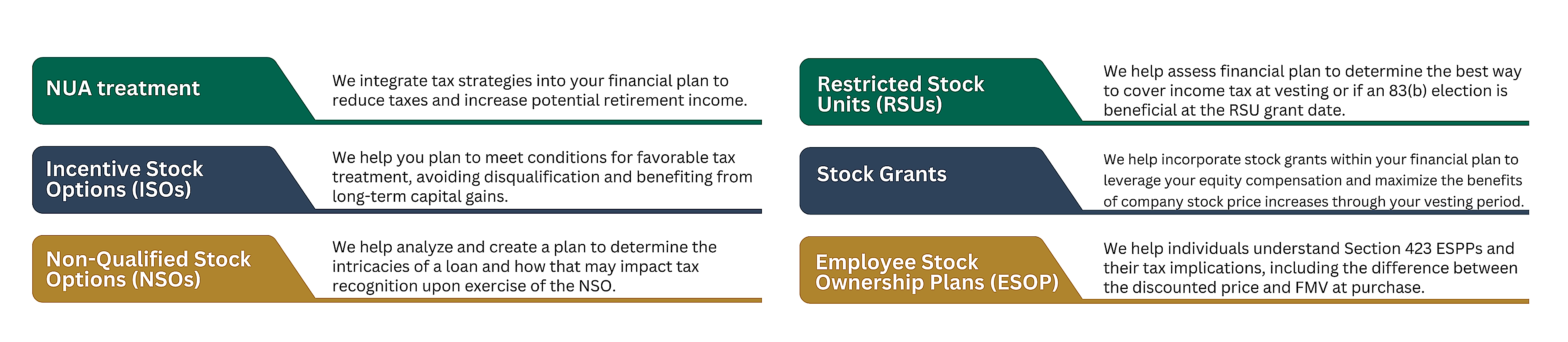
Company Stock Plan Strategies
Understanding your equity incentive plan is crucial to maximizing your benefits. Our experts guide you through how these plans can enhance your resources in retirement.
Company stock plans are an essential component of your employee benefits, offering you a stake in your company’s success. Understanding the different types of equity incentives is key to making informed financial decisions. We will help you understand your individual equity incentive plan so you can make the best decision for your financial future.
Types of Equity Incentive:
- Net Unrealized Appreciation (NUA)
- Incentive Stock Options (ISOs)
- Non-Qualified Stock Options (NSOs)
- Restricted Stock Units (RSUs)
- Stock Grants
- Employee Stock Ownership Plans (ESOPs)
Our Advantage

Our team understands that company stock plans are more than just a part of an employee’s salary—they’re a partnership between employee and employer. We know how company stock plans are an important part of employee benefits and can help you understand the different types of equity compensation.
Our team understands how different employee benefit plans play a role in an employee’s retirement. We help employees understand the intricacies of their plan and determine timelines, tax, and redemption plan strategies to maximize retirement benefits.
Frequently Asked Questions
What are company stock plans?
Company stock plans are employee benefits that allow employees to own a stake in their company. These plans typically offer equity compensation, which can take various forms such as stock options, restricted stock units (RSUs), or employee stock ownership plans (ESOPs).
Why are company stock plans important for retirement planning?
Company stock plans can play a crucial role in retirement planning by providing employees with the opportunity to accumulate wealth through ownership in a successful company. By understanding the specifics of these plans, employees can strategically leverage them to enhance their retirement savings.
What are the different types of equity incentive plans?
There are several types of equity incentive plans, including:
- Net Unrealized Appreciation (NUA)
- Incentive Stock Options (ISOs)
- Non-Qualified Stock Options (NSOs)
- Restricted Stock Units (RSUs)
- Stock Grants
- Employee Stock Ownership Plans (ESOPs)
Each type has its own benefits and tax implications, and understanding these options is key to maximizing their potential.
What Is NUA for Company Stock?
NUA, or net unrealized appreciation, may apply when employer stock is held inside a qualified retirement plan. It can create tax-planning opportunities when company shares are distributed correctly, but timing, cost basis and rollover decisions must be reviewed carefully.
For deeper guidance, review our NUA for company stock page.
How Should I Plan for Equity Compensation Before Changing Jobs?
Before changing jobs, review your vesting schedule, option expiration dates, exercise deadlines, tax exposure and company stock concentration. Some equity awards may expire or be forfeited after separation, so decisions should be reviewed before your employment transition is final.
For more detailed guidance, visit our equity incentive plans page.
What Happens to Company Stock During a Merger or Acquisition?
During a merger or acquisition, company stock benefits may be converted, cashed out, accelerated, replaced or cancelled depending on transaction terms. ISOs, NSOs, RSUs, restricted stock, ESOP benefits and employer stock inside retirement plans may each be handled differently.
A coordinated company stock plan review can help you understand tax timing, liquidity decisions, concentration risk and next steps before making major financial moves.
What are Incentive Stock Options (ISOs)?
ISOs are a type of stock option that provides employees with the right to purchase company stock at a discounted price. If certain conditions are met, ISOs offer favorable tax treatment compared to non-qualified stock options (NSOs), making them an attractive equity incentive for employees.
What Are Restricted Stock Units?
Restricted Stock Units are a form of equity compensation where employees receive company shares after vesting conditions are met. Once RSUs vest, they are generally treated as taxable income.
How does Net Unrealized Appreciation (NUA) work?
NUA is a tax strategy that allows you to transfer company stock from your retirement plan to a taxable account while potentially, eliminating ordinary income tax on the cost basis and reducing long-term capital gains tax. It’s a strategy that can help maximize retirement savings, but it requires careful planning and understanding of tax laws and timing nuances.
How do Employee Stock Ownership Plans (ESOPs) work?
ESOPs are retirement plans that allow employees to acquire stock in the company they work for. They can be used as an employee benefit and are designed to provide employees with an ownership stake in the company, often enhancing to their retirement savings.
How can Konza Global Wealth Group help me with my company stock plan?
Konza Global’s team of experts can help you understand the intricacies of your company stock plan, including tax strategies, retirement planning, and optimal decision-making for your specific equity compensation plan. We help you maximize the value of your company stock plan while integrating it into your broader financial strategy.
What should I consider when making decisions about my company stock plan?
When making decisions about your company stock plan, consider factors such as tax implications, your investment horizon, risk tolerance, and retirement goals. It’s important to work with an advisor to create a strategy that aligns with your long-term financial objectives and maximizes the value of your equity compensation.

Tell us your financial aspirations, and we’ll handle the rest
Our team actively manages your portfolio using tailored strategies that maximize returns and minimize risk — providing you with reports and insights every step of the way.