

For decades, retirement accounts such as Traditional IRAs and 401(k)s have allowed Americans to save for retirement while deferring taxes. However, the IRS eventually wants to collect tax income from those tax-deferred dollars. That’s where Required Minimum Distributions, commonly known as RMDs, come into play.
Understanding RMDs is an important part of retirement income planning and how they can impact your taxes, Medicare premiums, Social Security taxation, and overall retirement strategy.
What Are Required Minimum Distributions?
A Required Minimum Distribution (RMD) is the minimum amount that must be withdrawn each year from certain retirement accounts once you reach a specified age that is based on your year of birth.
Retirement accounts such as Traditional IRAs and 401(k)s allow contributions and investment growth to occur tax-deferred. Without RMD rules, individuals could potentially leave money in these accounts indefinitely and avoid paying taxes for decades.
RMDs require that tax-deferred retirement savings eventually become taxable and allow the government to collect tax money on balances that has have often compounded over decades.
The amount required to be withdrawn is generally taxed as ordinary income in the year it is received.
What Accounts Are Subject to RMDs?
RMD rules apply to most tax-deferred retirement accounts, including:
Traditional IRAs
Rollover IRAs
SEP IRAs
SIMPLE IRAs
401(k) plans (pre-tax contributions)
403(b) plans (pre-tax contributions)
457 plans (pre-tax contributions)
Inherited retirement accounts (subject to separate rules)
RMDs do not apply to:
Roth IRAs owned by the original account holder
Health Savings Accounts (HSAs)
Taxable brokerage accounts
One of the major advantages of Roth IRAs is that the original owner is not required to take any lifetime distributions.
At What Age Do RMDs Begin?
The age at which RMDs begin has changed several times through legislation.
Current rules are:
Age 73 for individuals born between 1951 and 1959
Age 75 for individuals born in 1960 or later
The SECURE Act and SECURE 2.0 Act gradually increased the starting ages from the previous age of 70½ and 72.
For many retirees, this means additional years of tax-deferred growth before mandatory withdrawals begin.
How Are RMDs Calculated?
The IRS determines your annual RMD using a simple formula:
Account Balance ÷ IRS Life Expectancy Factor
The account balance is typically measured as of December 31 of the previous year.
For example:
IRA balance on December 31: $500,000
IRS factor at age 73: 26.5
RMD = $500,000 ÷ 26.5 = $18,868
The distribution amount changes each year because:
Account balances fluctuate
Life expectancy factors decline with age
As you get older, the percentage of your account that must be distributed generally increases.
The First-Year RMD Rule
Your first RMD can be delayed until April 1 of the year following the year you reach your required beginning age.
While this may sound attractive, there is an important catch.
If you delay your first RMD:
You must still take your second year’s RMD by December 31 of that same year.
This could result in two RMDs occurring in one tax year.
For some retirees, this may push income into higher marginal tax brackets or create other tax consequences.
Because of this, many retirees choose to take their first RMD during the year it becomes due.
What Happens If You Miss an RMD?
Historically, missing an RMD carried one of the harshest penalties in the tax code.
SECURE 2.0 reduced the penalty, but it can still be significant.
Current penalties may be:
25% of the amount not withdrawn
Potentially reduced to 10% or less if corrected promptly and Form 5329 is filed explaining the circumstances and correction made.
If an RMD is missed, it is generally important to correct the error as quickly as possible and consult a qualified tax professional to make sure it is done correctly.
Why RMDs Matter
Many retirees initially view RMDs as merely an administrative requirement. In reality, they often play a significant role in retirement planning.
Increased Taxable Income
RMDs are taxed as ordinary income.
As account balances grow and the IRS Life Expectancy Factor decreases, required distributions may become substantial.
For retirees with large IRAs, RMDs can push taxable income significantly higher than expected.
Social Security Taxation
RMD income may increase the portion of Social Security benefits subject to taxation.
While Social Security is often viewed as tax-free, up to 85% of benefits may become taxable depending on income levels.
Medicare Premiums (IRMAA)
Higher income can trigger Medicare premium surcharges known as IRMAA (Income Related Monthly Adjustment Amounts).
A large RMD may increase:
Medicare Part B premiums
Medicare Part D premiums
In some situations, a relatively small increase in income can result in substantially higher Medicare costs.
Widow’s Penalty
Many married couples file jointly during retirement.
When one spouse passes away, the surviving spouse often moves from Married Filing Jointly tax brackets to Single tax brackets.
The surviving spouse may continue receiving large RMDs while facing higher marginal tax rates, a situation commonly referred to as the widow’s penalty.
How to Manage RMDs
Although RMDs cannot be avoided indefinitely, there are several strategies that may help manage their impact.
Early Roth Conversions
One of the most widely used tax-planning strategies is a Roth conversion.
By converting portions of a tax-deferred retirement accounts such as a Traditional IRA to a Roth IRA before RMD age, investors may:
Reduce future IRA balances
Lower future RMDs
Create tax-free retirement assets with the Roth IRA
Many retirees use the years between retirement and RMD age as a window for strategic Roth conversions.
Qualified Charitable Distributions (QCDs)
Individuals age 70½ and older can make Qualified Charitable Distributions directly from an IRA to a qualified charity.
Benefits include:
Satisfying RMD requirements while;
Excluding the distribution from taxable income
Potentially reducing higher Medicare and Social Security tax impacts
For charitably inclined retirees, QCDs can be one of the most tax-efficient giving strategies available.
Strategic Withdrawals Before RMD Age
Some retirees intentionally withdraw funds before RMDs begin.
By spreading distributions over multiple years, they may avoid larger required withdrawals later in retirement while also managing their taxes during pre-RMD years.
This approach may help spread income more evenly over time and reduce the size of future RMDs.
Asset Location
Thoughtful asset location may help improve after-tax outcomes.
Investors often consider:
Taxable accounts
Tax-deferred accounts
Tax-free accounts
Managing withdrawals across multiple account types can provide greater tax flexibility during retirement.
Special Rules for Workplace Plans
Employer-sponsored plans such as 401(k)s may have different RMD considerations.
In some situations, individuals who continue working beyond RMD age may be able to delay RMDs from their current employer’s plan if they own less than 5% of the company.
This exception does not apply to Traditional IRAs.
Rules vary based on plan design and ownership percentages, so review plan documents carefully.
Inherited Account Considerations
Beneficiaries who inherit retirement accounts face their own set of RMD rules.
The SECURE Act introduced the 10-Year Rule for many non-spouse beneficiaries.
Depending on the beneficiary and account type, inherited account distribution requirements can differ significantly from lifetime RMD rules.
These situations often warrant professional planning and tax guidance.
Konza Global Wealth Group Strategic Advantages Section
How Konza Global Wealth Group Utilizes Our “RMD Tax Alpha Process”
Our “RMD Tax Alpha Process” looks beyond the RMD calculation by connecting a client’s current required distributions with their comprehensive financial picture.
While many Advisors view RMDs as a simple distribution event, Konza Global Wealth Group coordinates RMDs around recurring retirement income, tax impact, investment positioning, charitable giving and estate and legacy planning.
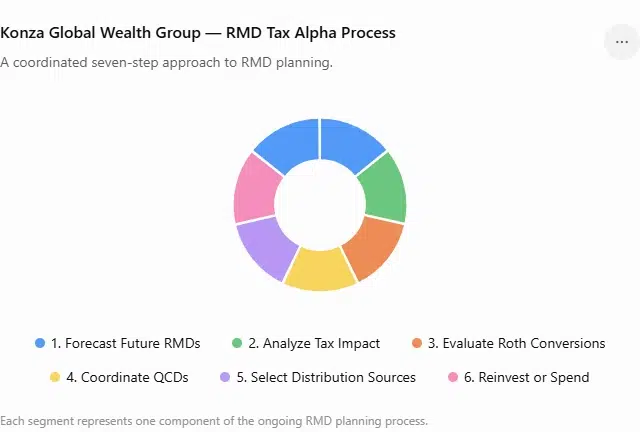
Konza Global Wealth Group’s RMD Tax Alpha Process
Our RMD Tax Alpha Process incorporates a seven-step approach to RMD planning:
Final Thoughts
Required Minimum Distributions are an unavoidable part of retirement planning for most individuals with tax-deferred retirement accounts. While they are designed with the framework that the IRS will eventually collect taxes on retirement savings, tax-deferred accounts can also create challenges involving tax brackets, Medicare premiums, Social Security taxation, and estate & legacy planning.
The good news is that RMDs are not simply something that happens to you. With proactive planning and guidance from a financial professional, retirees can often evaluate strategies such as Roth conversions, Qualified Charitable Distributions (QCDs), strategic withdrawal sequencing, and tax-efficient retirement income planning to help manage future RMD exposure.
Understanding how RMDs fit into your broader retirement plan before they begin may create opportunities to improve tax efficiency, reduce future Medicare premium surcharges, and provide greater flexibility throughout retirement years. In many cases, the most valuable planning opportunities occur years before the first RMD is ever required.
